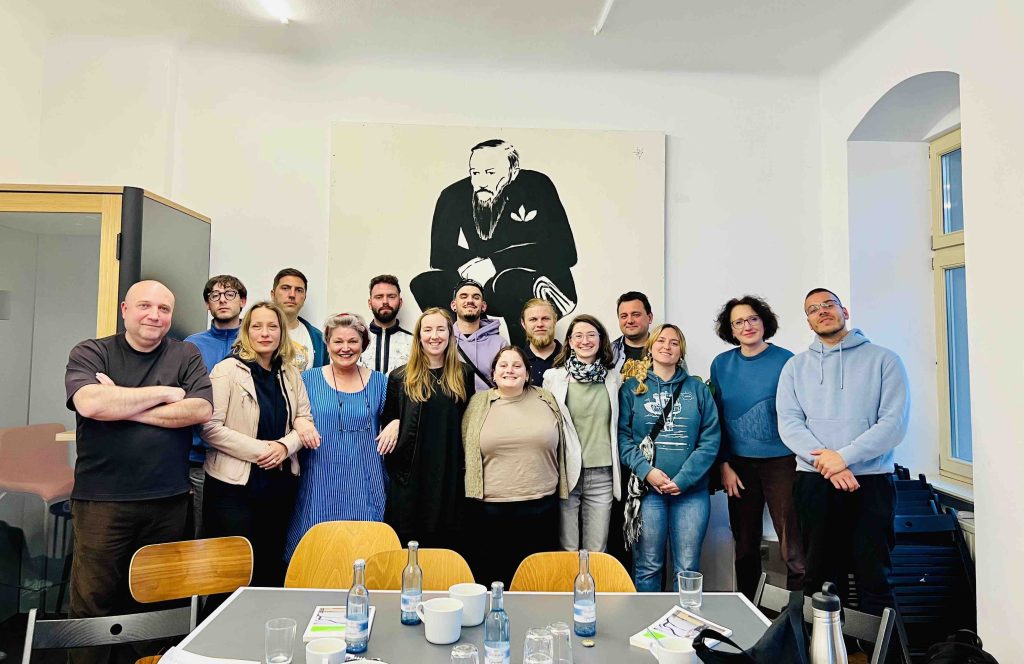
Our final visit brought a notable shift in pace and perspective. After exploring global peace missions at ZIF and experiential education with CRISP, we arrived at CISR – Center for Independent Social Research, an organization that doesn’t just address conflict on the outside, but interrogates the social narratives and internalized worldviews that sustain it.
CISR’s work is rooted in critical, post-Soviet social research, focusing on how militarism, nationalism, and exclusion are reproduced in everyday life — through language, media, memory, and identity. Based in Berlin but with deep ties to Eastern Europe and the Caucasus, CISR acts as both a research hub and an educational platform for social transformation.
A Different Kind of Peacebuilding
Rather than offering toolkits or trainings in the traditional sense, CISR creates slow, reflective spaces for dialogue — often among groups who carry historical trauma, mistrust, or contested identities. One of their most powerful initiatives is the Demilitarising Mind project, which brings together participants from Armenia, Azerbaijan, Georgia, Russia, and Ukraine for summer schools, storytelling workshops, and joint reflection.

In these gatherings, the focus is not on resolving conflict in any immediate or diplomatic sense. Instead, it’s about making visible the inherited narratives that shape how people see each other — and themselves — across lines of division. One of the facilitators shared:
“Before we can talk about peace, we need to understand what war has done to our imagination.”
This approach to peacebuilding is less about intervention and more about intellectual and emotional deconstruction. It’s slow, often uncomfortable work — but it lays the groundwork for new solidarities that are built not through consensus, but through mutual recognition.
What We Took With Us
Participants asked thoughtful questions about how this kind of work can influence broader social or political processes. How do you scale something that is intentionally small and deeply contextual? How do you measure the impact of unlearning?

There were no easy answers — but perhaps that’s the point. CISR challenges the notion that peace is something to be achieved quickly or defined universally. Instead, it suggests that sustainable peace might begin in the most fragile of places: in honest conversation, in shared uncertainty, and in the willingness to stay with complexity.
As we left CISR, it was clear that while their methods may be less visible than large missions or public campaigns, their impact is no less profound. They remind us that transforming conflict is not only about institutions or tools — it’s also about transforming ourselves.